1. Camouflage
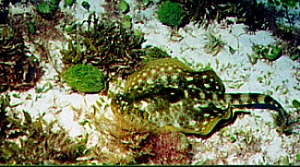
The Golden Stingray can change colors to blend in with its surroundings.
|

The Golden Ray is difficult to see on the sandy bottom.
|
Many ocean organisms use camouflage to ambush prey
or to hide from predators. Use the links to find another organism that
uses camouflage. Draw or print out a picture and label the organism.
TOP
2. Venom, poison or stinging cells

(video - mpeg format 925 KB)
|
|
Jellyfish have tentacles that hang down from its bell. The tentacles
contain stinging cells called nematocysts that stun or paralyze prey. Click
on the picture to view the video.
|
Use the links to find another organism that uses venom
or stinging cells. Draw or print out a picture and label the organism.
TOP
3. Armor
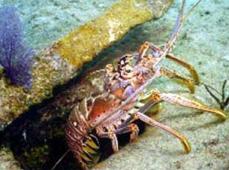
The Reef Lobster's hard shell protects it.
|
 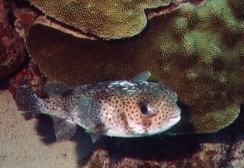
The Porcupine fish puffs up and sharp spines stick out
when it is
disturbed or frightened.
|
Use the links to find another organism that uses
armor to protect itself. Draw or print out a picture and label it.
TOP
4. Specialized Appendages
The graceful Eagle Ray has elongated fins that act
like wings helping it to glide and "fly" through the water.
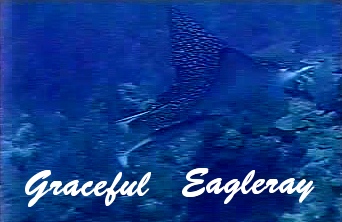
Click to view video
mpeg format 1.3 MB
TOP
5. Symbiotic Relationships
In symbiotic relationships, each organism benefits from
the other. The benefit can be protection from predators, the removal of
parasites or diseased tissue or can be a source of food for one or both
organisms. Try to identify how each organism benefits in the relationships
below.
Click on each of the pictures to view the videos. (It will take
a few moments to load the files.)
mpeg format 1.6 MB
|
mpeg format 1.2 MB
|
TOP
6. Scuba Equipment as Adaptations
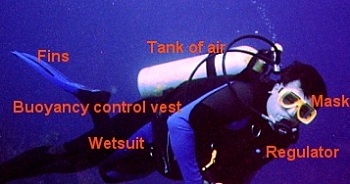
When human beings explore the ocean environment, they
need to add specialized equipment to be able to move and breathe underwater.
Divers use several pieces of specialized equipment.
-
A regulator and a tank of air allow the diver to breathe underwater.
-
A mask helps the diver see clearly.
-
Fins help the diver move more quickly and with less effort.
-
A buoyancy control vest (along with a weight belt) help the diver control
his/her depth. The diver can put air into or let air out of the vest. This
allows the diver to hover or "float" at certain depths without sinking
or going up.
-
A wetsuit helps keep the diver warm by adding a layer of insulation.
|
|
Let's
Get Creative!
Now that you know about various
adaptations you can design a new marine organism, a predator or a prey.
Give your organism specialized body parts or abilities that help it live
in the coral reef. Create a model or a drawing of your organism.
|